
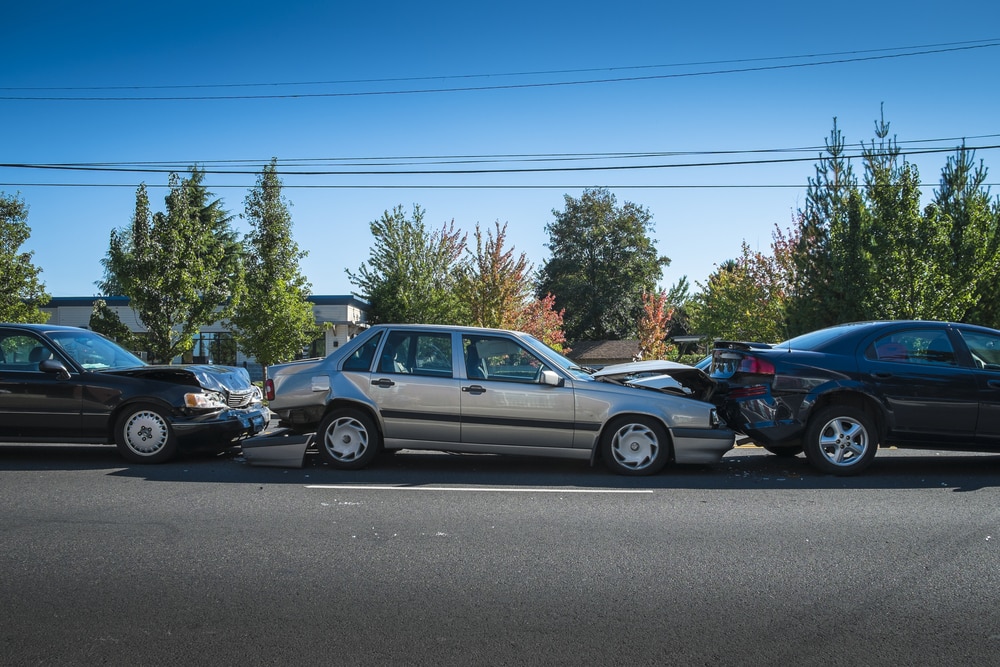
Identifying the At-Fault Party in a Chain-Reaction Car Accident
Chain reaction crashes happen when a triggering event causes an initial crash. Other nearby vehicles then subsequently collide with each other because of the initial crash. In most cases, the driver who was at fault in the initial accident will be the at-fault party. For example, if one driver fails to notice that traffic has slowed in front of his or her vehicle, he or she might have a rear-end accident, causing the front car to collide into the rear of the vehicle in front of him or her, injuring both the driver who was initially hit and the driver who was subsequently hit. In this type of case, the driver who caused the first rear-end accident will likely be liable for both collisions.
However, the first driver is not always the at-fault party in a chain-reaction car accident. For example, if the front driver did not have working brake lights, the rear driver might not have enough time to reach and avoid colliding into the front car’s rear. When that front driver then collides into the rear of the vehicle in front of him or her, injuring that driver, the middle driver would be at fault for failing to keep his or her brake lights in working order.
When Several Parties Share Fault
In some chain-reaction car accidents, more than one party will share fault for causing the accident and resulting injuries. When the liability of the various involved parties is unclear, an attorney might work with an accident reconstruction expert to help determine each party who contributed to the cause of the collision.
For example, when a motorist is tailgating a vehicle in front of him or her, and the front vehicle slams on his or her brakes without warning and causes a chain-reaction collision, both of the initially involved drivers might share fault and be jointly and severally liable to pay damages to injured accident victims.
Insurance Considerations in Massachusetts
As previously mentioned, Massachusetts is a no-fault state for car accidents. This means that you will submit a claim to your own auto insurance company after an accident. Your PIP coverage will pay for up to $8,000 in your medical expenses regardless of fault. These benefits are known as first-party benefits in Massachusetts.
In a chain-reaction crash, you might be able to file a lawsuit against each responsible party as long as your injuries are serious. Serious injuries are those that result in a serious impairment to a bodily function, scarring and disfigurement, or death. If your injuries meet these thresholds, you can file a lawsuit against the party or parties who caused the chain-reaction accident.
If you were partially to blame for the accident, your recovery will not be barred as long as your percentage of fault was 50 percent or less under Massachusetts’ modified comparative fault rule. Under this law, your damages will be reduced by your percentage of fault. For example, if a jury determines that you were 20 percent at fault and awards you $100,000 in damages, your award will be reduced by 20 percent to $80,000.
Get Help from the Experienced Lawyers at Ellis & Associates
Chain-reaction car accident claims are complex. They can be even more complicated when several parties share fault. If you have sustained serious injuries in this type of collision, you should talk to one of the experienced Massachusetts personal injury lawyers at Ellis & Associates as soon as possible. Our attorneys can investigate the crash and work with experts to identify all of the liable parties. Call Ellis & Associates for a free consultation at 800-MR-ELLIS.